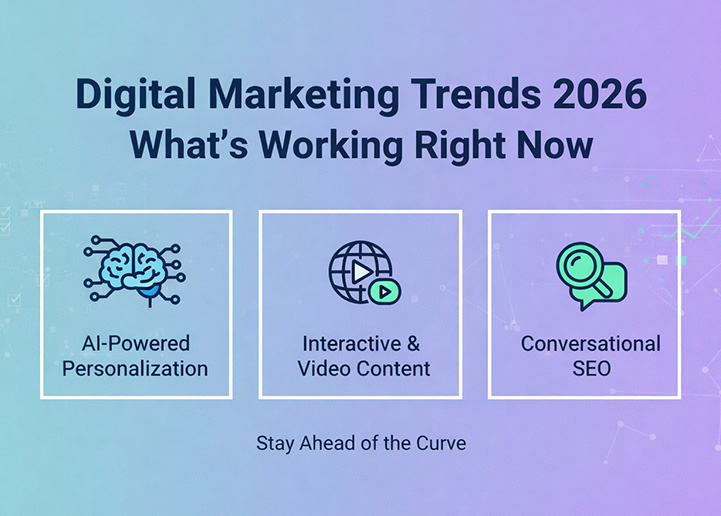
Digital Marketing Trends 2026: What’s Working Right Now
Digital marketing in 2026 isn’t about chasing shiny new tools or jumping on every trend that pops up on your feed. It’s about understanding how people behave today, how technology supports that behavior, and how brands can show up in ways that feel natural, helpful, and human.
The rules have changed. Audiences are smarter, platforms are faster, and attention is harder to earn. The brands winning right now are the ones that blend innovation with authenticity.
Here’s what’s actually working in digital marketing in 2026.
1. AI Is No Longer Optional, It’s the Backbone of Marketing
AI has quietly moved from being a “nice-to-have” tool to becoming the foundation of modern digital marketing. In 2026, marketers aren’t asking whether to use AI, they’re deciding how to use it wisely.
AI now supports:
Content creation and ideation
Audience segmentation and targeting
Predictive analytics and campaign optimization
Automated customer journeys
But the real shift is this: AI works best when guided by human thinking.
Brands that rely entirely on automation often sound robotic. The most effective teams use AI for speed and efficiency, while humans focus on strategy, creativity, and emotional connection.
AI helps you move faster. Humans help you move smarter.
2. Search Has Evolved Beyond Keywords
Search in 2026 looks very different from what it did just a few years ago. People no longer search only through browsers. They ask questions through voice assistants, AI tools, and conversational platforms.
Instead of typing short keywords, users ask full questions:
“What’s the best skincare routine for oily skin?”
“Which payment apps are safest right now?”
This shift means brands must focus on answer-driven content, not keyword stuffing.
Clear, structured content that directly answers questions
Topic authority instead of single-keyword targeting
Helpful, human explanations over technical jargon
Being visible today isn’t just about ranking first, it’s about being trusted enough to be recommended.
3. Short-Form Video Still Dominates Attention
Short-form video continues to be the most powerful format in 2026. Platforms prioritize it, audiences prefer it, and algorithms reward it.
But the format has matured.
People are no longer impressed by flashy edits alone. What performs now is relatable, story-driven content.
Real stories instead of polished ads
Strong hooks in the first 3 seconds
Everyday creators overproduce campaigns
Educational, emotional, or entertaining value
Brands that treat short videos like conversations instead of commercials see higher engagement and trust.
4. Personalization Is Expected, Not Impressive
In 2026, personalization isn’t a bonus; it’s the baseline.
Audiences expect brands to:
Remember their preferences
Show relevant content
Recommend products they actually need
This level of personalization is driven by behavioral data, not just demographics.
Dynamic emails based on past actions
Customized landing pages
Product recommendations tied to browsing behavior
Ads that adapt in real time
When done right, personalization feels helpful. When done wrong, it feels invasive. The difference lies in respecting user intent and privacy.
5. Influencer Marketing Has Become Creator-Led Growth
Influencer marketing in 2026 is no longer about one-off posts or follower counts. It’s about long-term creator partnerships and measurable impact.
Audiences trust creators because they feel real. They don’t want scripted brand messages; they want honest experiences.
Micro and nano creators with high engagement
Long-term collaborations instead of single campaigns
Creator freedom over rigid brand scripts
Performance-based tracking (not just reach)
Creators are no longer just promotional channels; they’re growth partners.
6. Social Media Is Now a Shopping Destination
People don’t scroll social media just to consume content anymore. They scroll to discover products, read reviews, and make purchase decisions.
Social commerce has matured, allowing users to:
Discover products through creators
Learn through short videos and reviews
Purchase without leaving the app
The brands winning here focus on:
Storytelling over selling
Seamless user journeys
Trust-based content
When content feels genuine, conversion happens naturally.
7. Conversational and Voice Search Are Growing Fast
More users are speaking to devices instead of typing. Voice and conversational search demand content that sounds natural and human.
This means:
Writing in simple language
Answering questions directly
Structuring content like conversations
The goal is no longer to impress search engines; it’s to help people quickly and clearly.
8. First-Party Data Is the New Gold
With stricter privacy regulations and declining third-party tracking, brands now rely on first-party data, information users willingly share.
This includes:
Email subscriptions
SMS opt-ins
Loyalty programs
On-site behavior with consent
Trust is the currency here. Brands that are transparent about how data is used build stronger, longer-lasting relationships.
9. Brand Values and Authenticity Influence Buying Decisions
Consumers in 2026 don’t just buy products; they buy beliefs.
They pay attention to:
How brands communicate
What they stand for
Whether their actions match their words
Purpose-driven storytelling, ethical practices, and genuine messaging build emotional loyalty. Brands that fake authenticity are quickly called out.
10. Marketing Is No Longer Channel-Based, It’s Experience-Based
Marketing teams no longer work in silos. Social, email, paid ads, influencers, and content all connect into one ecosystem.
Successful brands focus on:
Consistent messaging across platforms
Seamless customer journeys
Data-driven decisions
Instead of managing channels, marketers now design experiences.
Addtitans Digital is Affordable digital marketing agency in India and one of the most trusted and established name in Digital Marketing World. We offer Digital Marketing Services from Media and Creative to Search, Analytics, Mobile, Social, ORM, Affiliate marketing.
204, U.S.Complex, 120, Mathura Road, Jasola, New Delhi - 110076, India
Dubai Address
24670-001, Dubai Silicon Oasis, DDP, Building - A2, Dubai, U.A.E


© 2022 Addtitans | All Rights Reserved
 +91-1147567169