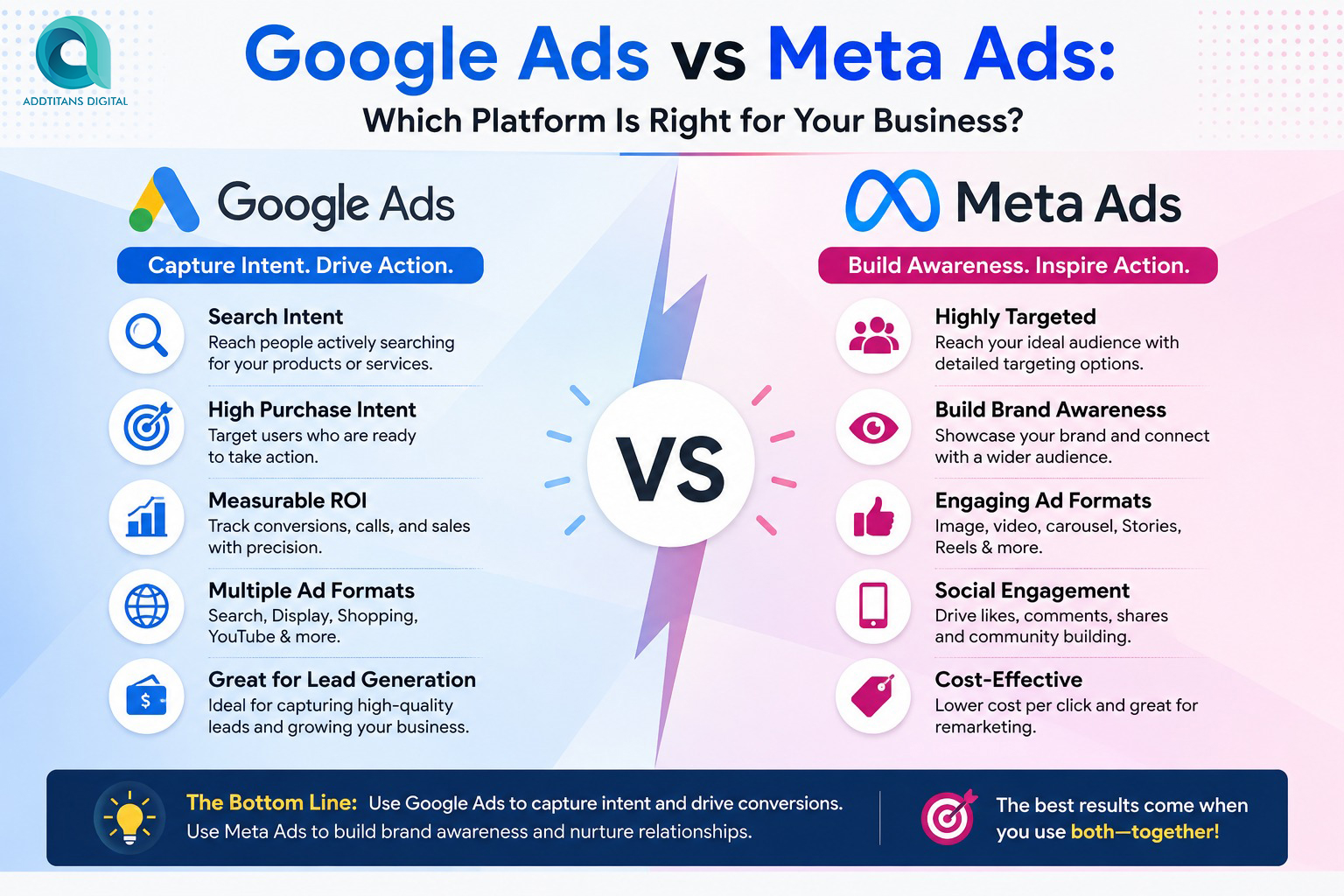
Google Ads vs Meta Ads: Which Platform Is Right for Your Business?
In an age where customers discover, compare, and purchase products online, having a strong digital presence is no longer a competitive advantage; it is an indispensable business necessity. And digital advertising is the best way to build a sustainable online presence and reach your ideal audience. Among the most powerful digital advertising platforms, Google Ads and Meta Ads continue to dominate the digital space. While both can drive exceptional results, they serve different purposes and are designed to influence customers at different stages of their buying journey.
But which platform is right for your business? In this blog, we shall break down the key differences between Google Ads and Meta Ads, compare their strengths, and help you determine which one best aligns with your marketing goals.
Google Ads is Google’s proprietary platform that enables businesses to display ads across Google Search, YouTube, Gmail, Google Maps, and millions of websites within the Google Display Network. Its biggest strength is its intent-based marketing. People actively search for products or services using specific keywords, making them more likely to convert because they already have a need.
For example, if someone searches for "best digital marketing agency in Delhi" or "buy organic incense sticks online," they're already looking for a solution. Google Ads places your business right in front of these high-intent customers. It is best for businesses focused on generating qualified leads, driving e-commerce sales, attracting local customers, or reaching users with high purchase intent.
With a wide range of campaign types, including Search, Display, Shopping, Performance Max, and YouTube, along with precise keyword targeting and robust performance tracking, Google Ads enables businesses to maximize conversions and accurately measure their return on investment.
Meta Ads is the umbrella platform that lets you advertise across Facebook, Instagram, Messenger, and the Meta Audience Network. Unlike Google Ads, Meta focuses on interest-based discovery. Instead of waiting for customers to search, Meta introduces your brand to people based on their interests, demographics, online behavior, and lifestyle.
Imagine someone scrolling Instagram. They weren't planning to shop, but an eye-catching ad captures their attention, creating demand they didn't know they had. This makes Meta Ads incredibly powerful for brand awareness and customer engagement. They are an excellent
choice for businesses looking to build brand awareness, launch new products, or promote visually appealing offerings across industries like fashion, beauty, home décor, food, and lifestyle. Its engaging visual ad formats, cost-effective reach, and advanced retargeting capabilities make it a powerful platform for driving engagement, nurturing potential customers, and building long-term brand loyalty.
The biggest difference between Google Ads and Meta Ads lies in customer intent. Google Ads reaches users who are actively searching for a product or service, making it highly effective for generating immediate leads and conversions. Meta Ads, on the other hand, introduce your brand to users based on their interests, behaviors, and demographics, even before they begin searching. As a result, Google Ads is better suited for capturing existing demand, while Meta Ads excel at building brand awareness and driving product discovery.
When it comes to audience targeting, Google Ads primarily focuses on search keywords and user intent, helping businesses connect with people actively looking for specific products or services. Meta Ads, however, offer more advanced audience segmentation by targeting users based on demographics, interests, purchasing behavior, life events, hobbies, and lookalike audiences. This allows businesses to reach highly specific customer groups, making Meta Ads the stronger choice for precision audience targeting and personalized marketing campaigns.
Google Ads is most effective at the bottom of the marketing funnel, where users have a clear intent to make a purchase or submit an enquiry. Meta Ads, on the other hand, perform best at the top and middle of the funnel by introducing your brand to new audiences, building awareness, educating potential customers, and nurturing them until they're ready to convert. Together, they support different stages of the customer journey.
Advertising costs vary depending on your industry, target audience, and campaign objectives, so there's no one-size-fits-all answer. Google Ads tend to have a higher cost per click (CPC) due to intense competition for high-value keywords, while Meta Ads often provide lower CPCs and broader reach within the same budget. However, Google's higher CPC is frequently offset by stronger purchase intent, resulting in more qualified leads and a greater likelihood of conversion.
Both Google Ads and Meta Ads offer a wide variety of ad formats tailored to different marketing objectives. Google Ads includes Search, Shopping, Display, YouTube Video, App Promotion, and Performance Max campaigns, making it ideal for capturing demand across multiple touchpoints.
Meta Ads, on the other hand, feature highly engaging formats such as Image, Video, Reels, Carousel, Stories, Collection, and Instant Experience ads. If your business relies on compelling visuals to showcase products or tell a brand story, Meta Ads offer a distinct advantage.
The answer depends entirely on your business objectives:
Choose Google Ads if your primary goal is to generate immediate enquiries, drive website traffic, increase phone calls and appointment bookings, or capture high-quality leads from users who are already searching for your products or services. Meta Ads, on the other hand, is good for building brand awareness, reaching new audiences, increasing engagement, launching new products, or promoting visually appealing offerings. It's particularly effective for creating demand, nurturing customer relationships, and establishing long-term brand loyalty.
High-performing businesses rarely rely on one platform. Instead, they combine the strengths of both Google Ads and Meta Ads to guide customers through the entire buying journey. For e.g. A customer discovers your brand through an Instagram Reel. Later, they see another Facebook ad showcasing customer reviews. A few days afterward, they search your business on Google. Your Google Search Ad appears at the top of the results. They click. They convert. The integrated strategy ensures your brand remains visible at every touchpoint, improving conversion rates.
Ready to Grow your Business
Choosing the right platform for your business is only the first step of your online growth. To navigate and succeed, you’ll need to focus on strategic planning, creatives, precise audience targeting, continuous optimization, and data-driven decision-making.
At AddTitans, we help businesses turn advertising budgets into measurable business growth through performance-driven digital marketing strategies tailored to their unique goals. From generating qualified leads through Google Ads to building brand presence with Meta Ads, or creating a full-funnel digital marketing strategy, Addtitans is fully equipped with the resources and experts to help brands build a resounding presence.
Addtitans Digital is Affordable digital marketing agency in India and one of the most trusted and established name in Digital Marketing World. We offer Digital Marketing Services from Media and Creative to Search, Analytics, Mobile, Social, ORM, Affiliate marketing.
204, U.S.Complex, 120, Mathura Road, Jasola, New Delhi - 110076, India
Dubai Address
24670-001, Dubai Silicon Oasis, DDP, Building - A2, Dubai, U.A.E


© 2022 Addtitans | All Rights Reserved
 +91-1147567169