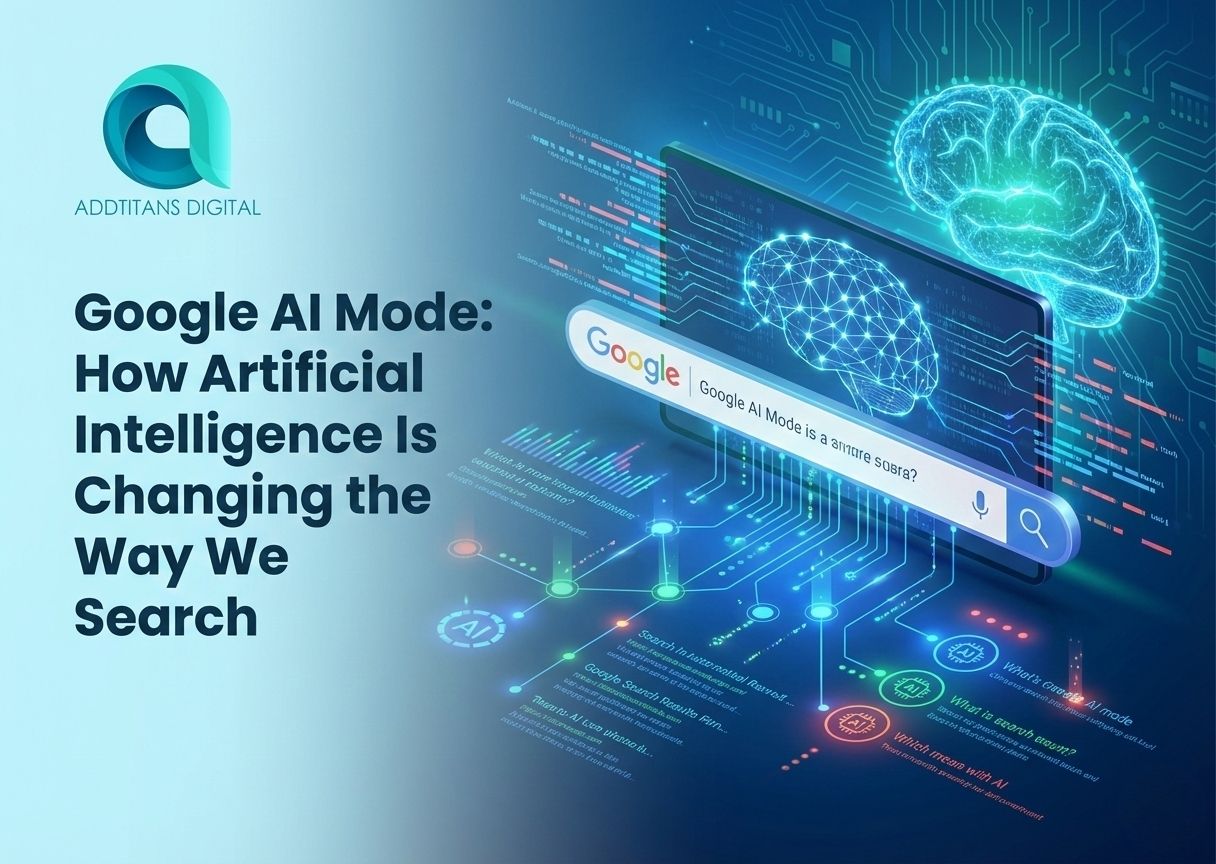
Google AI Mode: How Artificial Intelligence Is Changing the Way We Search
Remember when searching on Google meant typing a few keywords and scrolling through pages of blue links?
Those days are changing fast.
Google has introduced something called "AI Mode", and it's transforming how we find information online. Instead of just showing you a list of websites, Google now uses artificial intelligence to give you direct answers, summaries, and personalized responses.
For regular users, this means faster answers and less clicking around. For website owners and businesses, it's creating both exciting opportunities and serious challenges.
Let's break down what Google AI Mode really is, how it works, and what it means for everyone who uses the internet.
Google AI Mode is powered by advanced artificial intelligence that can understand your questions like a human would, not just match keywords.
When you search for something, instead of only giving you links to websites, Google's AI can:
Read and summarize information from multiple sources
Answer your question directly at the top of the results
Provide step-by-step explanations
Suggest follow-up questions you might want to ask
Personalize results based on your search history and preferences
Think of it like having a knowledgeable assistant who can quickly scan hundreds of sources and give you a clear, helpful answer, all in seconds.
This isn't just a small upgrade. It's a fundamental shift in how search engines work.
Traditional Google search has always been simple: you type something, and Google shows you a ranked list of websites that might have your answer. You click, read, and hopefully find what you need.
AI Mode changes this process completely.
Now, when you search for something like "how to fix a leaky faucet," instead of just getting links to plumbing websites, Google's AI might:
Show you a clear, step-by-step answer right at the top
Pull information from multiple expert sources
Include relevant images or videos
Suggest related questions like "what tools do I need?" or "when should I call a plumber?"
You might get your answer without ever clicking on a single website.
That's convenient for users, but it has big implications for website owners who rely on search traffic.
Google didn't introduce AI Mode just to be fancy. They had clear reasons:
Competition is heating up. New AI-powered search tools like ChatGPT and Microsoft's Bing with AI are attracting users who want direct answers instead of link lists.
User expectations have evolved. People want quick, accurate answers, not homework assignments that require clicking through ten websites.
Technology has advanced. Modern AI can understand context, nuance, and complex questions in ways that weren't possible just a few years ago.
Mobile searching demands it. On smartphones, scrolling through traditional search results is clunky. Direct answers work better on small screens.
Google is adapting to stay relevant in an AI-powered world.
For people just trying to find information, AI Mode offers some real advantages:
Faster answers. Get what you need without clicking through multiple websites.
Better understanding. The AI can interpret complex or vaguely worded questions and still give helpful responses.
Personalized results. Answers can be tailored to your location, interests, and previous searches.
Follow-up capability. You can ask clarifying questions and have a more conversational search experience.
Verified information. The AI pulls from multiple credible sources, potentially reducing misinformation (though this isn't perfect).
For busy people, students doing research, or anyone wanting quick facts, this is a genuine improvement.
Here's where things get complicated.
If Google's AI answers questions directly, users don't need to click through to websites. And if they don't click through, website owners face serious problems:
Less traffic. Fewer people visiting your site means fewer potential customers, readers, or clients.
Reduced ad revenue. Many websites depend on advertising income. Less traffic means less money.
Lower visibility. If AI answers replace your website in search results, your brand becomes invisible.
Harder competition. Getting featured in AI-generated answers requires different strategies than traditional SEO (search engine optimization).
Small businesses, bloggers, news publishers, and online retailers are all affected.
Smart website owners aren't panicking; they're adapting.
Here's what successful content creators are doing:
Creating deeper, more valuable content. Instead of basic information that AI can easily summarize, they're producing in-depth guides, unique insights, and expert analysis.
Focusing on experience and personality. AI can summarize facts, but it can't replicate personal stories, brand voice, or human connection.
Building direct relationships. Email lists, social media followers, and loyal communities matter more than ever when you can't rely solely on search traffic.
Optimizing for AI answers. Learning how to structure content so it's more likely to be featured or cited in AI-generated responses.
Diversifying traffic sources. Not depending exclusively on Google search for website visitors.
The key is providing value that AI summaries simply can't replace.
For local businesses: restaurants, shops, service providers, AI Mode has specific effects:
Better local results. AI can better understand location-based searches like "pizza near me" or "best plumber in Chicago."
Voice search optimization. As more people use voice commands with AI assistants, businesses need content that matches conversational language.
Review the importance increases. AI often highlights businesses with strong reviews and ratings.
Direct information display. Your business hours, contact info, and services might appear directly in AI answers, reducing the need for users to visit your website.
Local businesses need strong Google Business Profiles and consistent online information more than ever.
AI Mode isn't perfect. Like any AI system, it can make mistakes:
Sometimes it provides incorrect information pulled from unreliable sources.
It can misinterpret complex questions and give answers that miss the point.
Bias exists based on what information the AI was trained on.
It may oversimplify nuanced topics that require deeper understanding.
Users should still think critically and verify important information, especially for medical, legal, or financial questions.
Google is constantly working to improve accuracy, but AI isn't infallible.
AI Mode relies on understanding user behavior, which raises privacy questions:
Data collection: Google learns from your searches, location, and browsing habits to personalize results.
Profile building: Over time, Google's AI creates detailed profiles of user interests and preferences.
Third-party access: Questions remain about how this data might be used or shared.
Users who value privacy should review their Google settings and understand what data they're sharing.
AI Mode is just the beginning. Here's what experts predict for the future:
Fully conversational search. Asking follow-up questions naturally, like talking to a knowledgeable friend.
Multimodal search. Combining text, images, voice, and even video in search queries.
Predictive answers. AI anticipating what you need before you even ask.
Personalized AI assistants. Search experiences tailored entirely to your unique needs and preferences.
Integration everywhere. AI-powered search built into every app and device we use.
The line between search engines and AI assistants will continue to blur.
For people doing serious research, AI Mode is a double-edged sword:
Advantages:
Quick overviews of complex topics
Summaries that help understand dense material
Easy access to multiple perspectives
Time saved on initial research
Disadvantages:
Risk of oversimplified answers
Potential for missing important nuances
Less exposure to diverse sources
Temptation to rely on AI without deeper investigation
Students especially need to balance AI convenience with critical thinking and original research.
Want to get the most from Google's AI Mode? Here are some tips:
Ask specific questions. The more precise your query, the better the answer.
Use follow-up questions. Treat it like a conversation to dig deeper.
Verify important information. Don't blindly trust AI answers for crucial decisions.
Check the sources. Look at where the AI pulled its information from.
Combine AI with traditional search. Sometimes you still need to browse websites for complete information.
Addtitans Digital is Affordable digital marketing agency in India and one of the most trusted and established name in Digital Marketing World. We offer Digital Marketing Services from Media and Creative to Search, Analytics, Mobile, Social, ORM, Affiliate marketing.
204, U.S.Complex, 120, Mathura Road, Jasola, New Delhi - 110076, India
Dubai Address
24670-001, Dubai Silicon Oasis, DDP, Building - A2, Dubai, U.A.E


© 2022 Addtitans | All Rights Reserved
 +91-1147567169