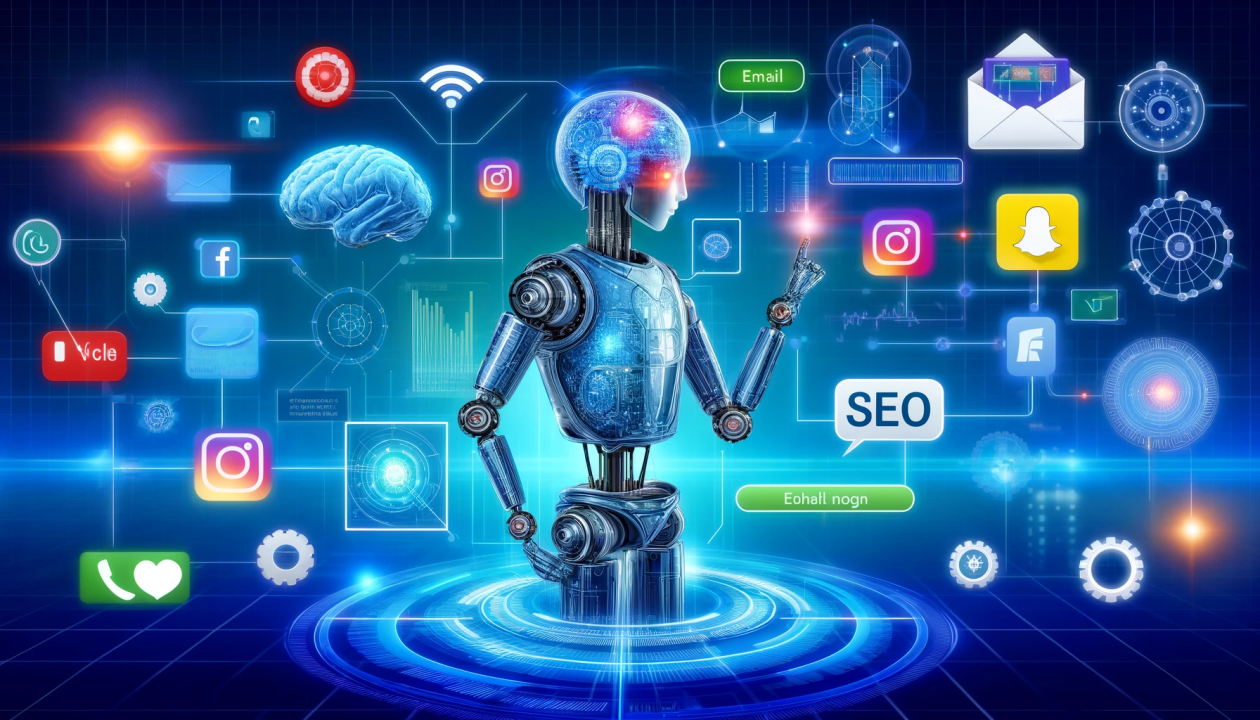
Welcome back to the channel. Today, we're diving into something that's completely transforming the digital marketing landscape right now
Hey everyone! Welcome back to the channel. Today, we're diving into something that's completely transforming the digital marketing landscape right now: artificial intelligence. And I'm not talking about some distant future scenario. This is happening right now, in 2025, and it's absolutely wild.
So grab your coffee, settle in, and let's talk about how AI is revolutionizing digital marketing agencies as we speak.
First things first, let's get real for a second. A couple of years ago, everyone was speculating about AI in marketing. "Will it replace marketers?" "Is it just hype?" Well, we're past that debate now. AI has become as essential to digital marketing agencies as email once was. It's not about whether you're using AI anymore; it's about how well you're using it.
And honestly? The agencies that figured this out early are absolutely crushing it right now. The ones that didn't? They're scrambling to catch up.
Let's start with the obvious one, content creation. This is where most people first encounter AI in marketing, and it's come so far that it's almost scary.
I remember when creating a month's worth of social media content would take a week of brainstorming, writing, editing, and scheduling. Now? AI tools can generate personalized content variations for different audience segments in minutes. But here's the thing, and this is important, the best agencies aren't using AI to replace their creative teams. They're using it to amplify them.
Think of it this way: AI handles the heavy lifting of initial drafts, headline variations, and content optimization. This frees up the actual humans to focus on strategy, brand voice refinement, and those creative sparks that AI still can't replicate. The result? Content that's both scalable and genuinely engaging.
I've seen agencies produce 10x the content they used to, without sacrificing quality. That's not an exaggeration, that's the new normal.
Remember when "personalization" meant inserting someone's first name into an email subject line? Yeah, we've come a long way.
AI is now enabling a level of personalization that would've required an army of marketers just a few years ago. We're talking about dynamic website content that adapts in real-time based on user behavior, emails that automatically adjust their messaging based on engagement patterns, and ad campaigns that optimize themselves across dozens of variables simultaneously.
One agency I know is running campaigns where every single user sees a slightly different version of the content, optimized for their interests, browsing history, time of day, device, and even predicted mood based on engagement patterns. Sounds like science fiction, right? But it's happening, and the conversion rates are through the roof.
The crazy part? This level of personalization is becoming expected by consumers. We're all getting used to experiences that feel tailored to us, and generic marketing is starting to feel... well, lazy.
Here's where things get really interesting. AI isn't just helping agencies react faster, it's helping them predict the future.
Modern AI systems can analyze massive amounts of data from past campaigns, market trends, consumer behavior, and even external factors like economic indicators or weather patterns to predict what's going to work before you even launch.
I talked to a CMO last month who told me their AI system predicted a campaign would underperform three days before launch. They made adjustments based on the AI's suggestions, and the campaign ended up exceeding targets by 40%. That's not luck—that's the power of predictive analytics.
Agencies are using AI to forecast customer lifetime value, predict churn before it happens, identify which leads are most likely to convert, and even determine the optimal time to reach out to prospects. It's like having a crystal ball, except this one actually works.
Let's talk about chatbots and AI customer service, but not the clunky, frustrating kind you're probably thinking of.
The AI customer service tools available in 2025 are sophisticated enough that most customers can't tell they're talking to a bot. They understand context, remember previous conversations, can handle complex queries, and know when to seamlessly hand off to a human agent.
For agencies managing multiple client accounts, this is a game-changer. AI handles the routine inquiries, troubleshooting, and basic support, while human agents focus on complex issues and relationship building. The result? Faster response times, happier customers, and support teams that aren't burning out from repetitive questions.
One e-commerce client I work with implemented an AI customer service system that now handles 70% of customer inquiries without human intervention. Their customer satisfaction scores went up, not down. Let that sink in.
Now, this is where things get controversial in the creative community, but hear me out.
AI tools are now designing ads, creating variations, and testing them at a scale that was previously impossible. We're not just talking about changing button colors or headlines; AI is creating entirely different visual concepts, layouts, and messaging strategies.
But here's what's actually happening in the best agencies: designers are using AI as a collaborative tool. They feed the AI their creative direction, brand guidelines, and strategic goals, and the AI generates hundreds of variations. The designers then select, refine, and polish the best options.
The result? More creative exploration, faster iteration, and better-performing ads. Plus, designers get to focus on high-level creative strategy rather than manually creating the 47th variation of the same ad.
Here's something most people aren't talking about enough: the rise of voice and visual search is massive, and AI is making it possible for agencies to optimize for these channels effectively.
People are searching by taking photos of products, using voice assistants, and even describing what they're looking for in natural language. AI helps agencies optimize content for these search methods, which are fundamentally different from traditional text-based search.
This means understanding natural language queries, optimizing images for visual search algorithms, and creating content that answers questions the way people actually ask them out loud. It's a whole new frontier, and AI is the compass.
Let's be honest, marketers have been drowning in data for years. We've had access to more information than we could analyze, and it's been overwhelming.
AI has changed this completely. Modern AI systems can analyze customer data across every touchpoint, identify patterns that humans would never spot, and provide actionable insights in real-time.
I'm talking about analyzing millions of data points to understand exactly which content formats perform best for which audience segments, at what times, on which platforms, with which messaging. The level of insight is almost absurd.
And the best part? These insights are presented in ways that actually make sense to humans. No more staring at spreadsheets trying to find meaning in the numbers.
Here's the plot twist that nobody saw coming: as AI handles more of the technical and repetitive work, the human elements of marketing have become more valuable, not less.
Strategy, empathy, brand storytelling, ethical decision-making, creative vision- these are things AI can assist with but can't replace. The agencies thriving in 2025 are the ones that figured out this balance.
They use AI to handle the "what" and the "how," while humans focus on the "why" and the "should we?" It's a partnership, not a replacement.
If AI has come this far by 2025, where are we headed? Honestly, I think we're just scratching the surface.
We're moving toward truly predictive marketing systems that can anticipate customer needs before customers themselves realize they have them. We're seeing AI that can generate entire campaign strategies, not just execute tactics. And we're heading toward a world where the line between AI and human creativity becomes increasingly blurred.
But here's what I know for sure: the agencies that embrace AI as a tool to enhance human creativity and strategic thinking are going to dominate the next decade. The ones that try to resist or rely on AI alone? They'll struggle.
AI is revolutionizing digital marketing agencies in ways we're only beginning to understand. It's making marketing more efficient, more personal, more predictive, and weirdly enough, more human.
The future of marketing isn't about choosing between AI and human marketers. It's about combining the computational power and tireless efficiency of AI with the creativity, empathy, and strategic thinking that only humans bring to the table.
And honestly? That future looks pretty exciting.
Thanks for hanging out with me today! If you found this valuable, hit that like button, subscribe for more marketing insights, and drop a comment below. I want to hear how you're using AI in your marketing efforts. Are you excited about these changes? Nervous? Let's talk about it.
Until next time, keep creating, keep innovating, and remember, AI is a tool, but you're the artist.
See you in the next one!
Addtitans Digital is Affordable digital marketing agency in India and one of the most trusted and established name in Digital Marketing World. We offer Digital Marketing Services from Media and Creative to Search, Analytics, Mobile, Social, ORM, Affiliate marketing.
204, U.S.Complex, 120, Mathura Road, Jasola, New Delhi - 110076, India
Dubai Address
24670-001, Dubai Silicon Oasis, DDP, Building - A2, Dubai, U.A.E


© 2022 Addtitans | All Rights Reserved
 +91-1147567169