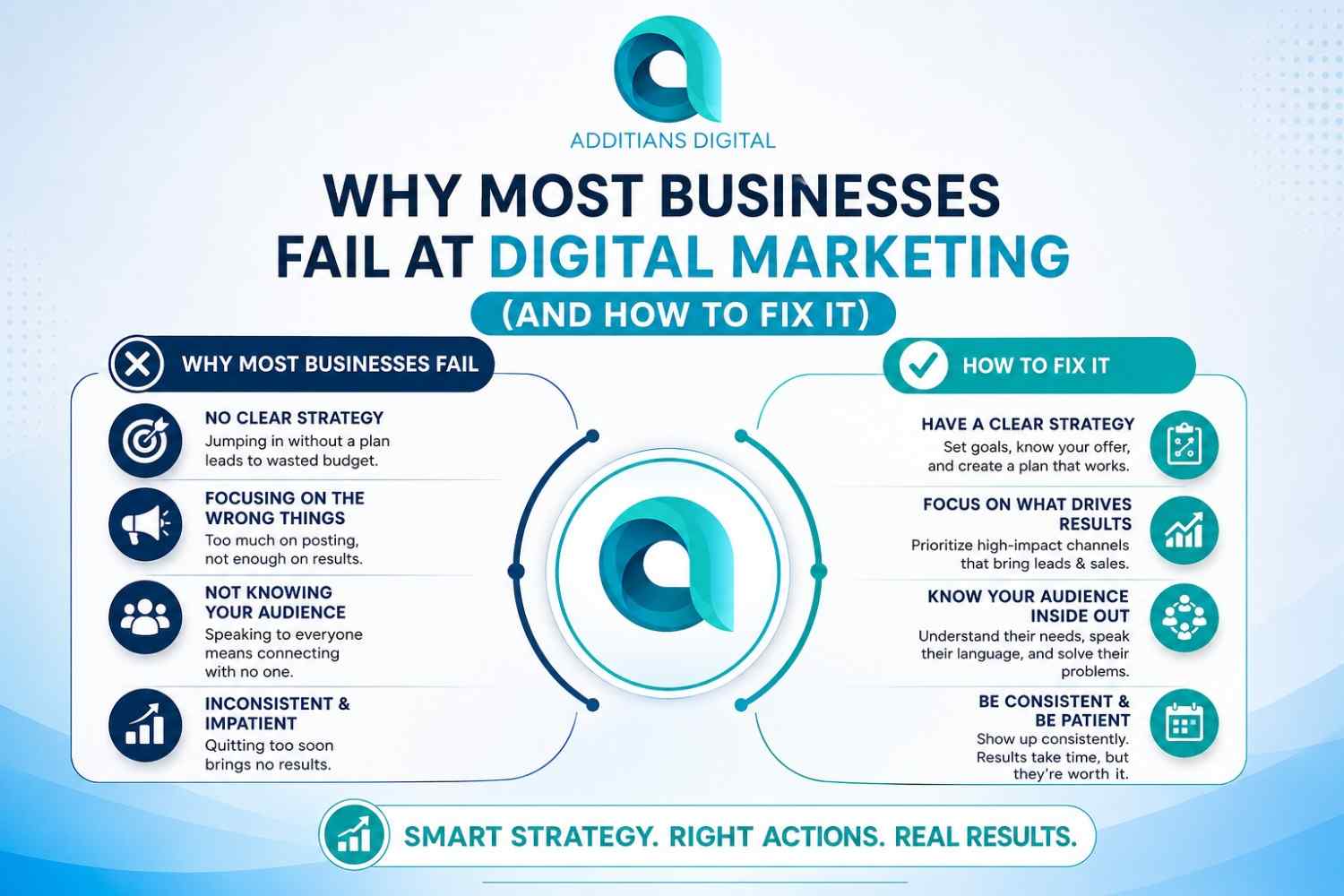
Digital marketing does not look complex in theory. If you show up where your audience is, say something useful, and make it easy for the audience to act, it looks simple on the surface.
Digital marketing does not look complex in theory. If you show up where your audience is, say something useful, and make it easy for the audience to act, it looks simple on the surface. Yet, most businesses consistently underdeliver on it. The problem isn’t a lack of effort. Brands are building on wrong audience data and running on assumptions from day one.
https://addtitans.com/service/best-digital-marketing-agency
They either treat it like a one-time project, use the budget on the wrong channels, or create content nobody asked for. The result is wasted resources, low returns, and a growing frustration that "digital marketing just doesn't work for us."
The truth is, digital marketing does work. It is the approach towards it that needs to be precise and tailored. Here is why most businesses fail at Digital Marketing, and how to fix it.
The most common mistake is treating digital marketing like a product launch rather than a system. A business builds a website, runs a few ads, posts on Instagram for a month, and wonders why nothing is working. Such brands need to understand that digital marketing is a compounding strategy. SEO takes months to build authority. Social media requires a consistent presence to earn trust. Paid campaigns need data before optimising them. None of this works on a trial basis. It is one of the reasons why most businesses fail at Digital Marketing.
Businesses need to build at least a 90-day goal before evaluating what is working. There should be a content calendar in place. Ownership is critical. And businesses should treat it like a function, not a project with a deadline.
Broad targeting may look safe. However, it is actually expensive and ineffective. When you're trying to speak to everyone, your message ends up meaning nothing to anyone. Most small and mid-size businesses skip the work of defining a specific audience persona. They write generic copy, run generic ads, and get generic results, including low click-through rates, high bounce rates, and poor conversion.
Many businesses invest heavily in paid ads and almost nothing in organic search. While that might work in the short term, it is actually a fragile strategy. The moment ad spending stops, so does the visibility.
Meanwhile, traditional SEO, including keyword-targeted content, proper meta structure, page speed, and internal linking, continues to drive traffic without ongoing spend. Most websites sit on technical issues that suppress rankings, like duplicate content, broken links, unoptimized images, and poor mobile experience. It is one of the main reasons why most businesses fail at Digital Marketing.
Start fixing these with a basic SEO Audit. Fix what's broken. Then build a content strategy around the keywords your customers actually use. Even publishing two well-optimised blogs a month compounds meaningfully over a year.
Most business owners aren’t exactly aware of their Cost Per Lead (CPL), email open rate, and other social media metrics. The vague data can lead to serious issues. Digital marketing without scalable metrics is just spending money and hoping for the best. The numbers are all there. Google Analytics, Meta Ads Manager, Search Console, email dashboards, everything is easily accessible. The problem is that most businesses don’t know which numbers matter or how to act on them.
Brands need to identify 3 to 5 KPIs that directly reflect traffic leads, conversion rate, cost per acquisition, and return on ad spend. Review them weekly and identify which one isn’t contributing to any of these.
This one is subtle but costly. Businesses often create content about what they want to say rather than what their audience wants to know. Product announcements, company milestones, and awards, which might be internally significant but externally irrelevant. Another good reason why most businesses fail at Digital Marketing.
Good content marketing starts with realizing what the audience is trying to solve, or decide right now. Prioritize that, and a brand will build credibility. Ignore it, and they are adding to that noise.
Brands need to shift from broadcast to value. For every piece of content, they need to understand if it educates, informs, solves a problem, or saves their time. That's what earns attention and search rankings.
Chasing every new platform is one of the fastest ways to burn budget and team bandwidth. Threads, Reels, YouTube Shorts, Newsletters, there's always somewhere new to be. Most businesses spread themselves thin trying to be everywhere and end up doing nothing particularly well.
The better approach would be to choose one or two channels where your audience is most active, and do those well before expanding. Master the format, understand the algorithm, build an audience. This will help a brand scale with proven traction.
Pattern Behind All of It
Those were some of the main reasons why most businesses fail at Digital Marketing. Most digital marketing failures come down to the same root issues -inconsistency, vague targeting, and lack of a proven way to measure success. Businesses that get it right aren't doing anything extraordinary. They are simply ensuring the fundamentals are on point. That means audience clarity, consistent content, basic SEO, and tracked metrics are there without cutting corners.
https://addtitans.com/service/best-digital-marketing-agency

Addtitans Digital is Affordable digital marketing agency in India and one of the most trusted and established name in Digital Marketing World. We offer Digital Marketing Services from Media and Creative to Search, Analytics, Mobile, Social, ORM, Affiliate marketing.
204, U.S.Complex, 120, Mathura Road, Jasola, New Delhi - 110076, India
Dubai Address
24670-001, Dubai Silicon Oasis, DDP, Building - A2, Dubai, U.A.E


© 2022 Addtitans | All Rights Reserved
 +91-1147567169